
Amerikano is a Turkish rummy-style card game, also known as Kut, where you race to empty your hand while meeting a different contract every round. To play Amerikano you form runs and sets from a double deck with jokers, open your hand by laying down exactly what the round demands, and then shed the rest of your cards before anyone else. Cards left in your hand are penalty points, and the lowest total after the last round wins.
This guide explains how to play Amerikano the way it is played in our iPhone and iPad game, Amerikano: Kart Oyunu. We built the game, so every rule, number and threshold below comes from its rules engine rather than from house rules or hearsay. It covers the cards, the three kinds of combination, every round in the Beginner and Advanced games, the round picker and its bonus gamble, out-of-turn pickups, scoring with worked examples, and the strategy that wins tables.
- Amerikano in 60 seconds
- The cards: two decks, jokers and 13-card hands
- The three combinations: Küt, Seri and Çift
- Every round: the Beginner and Advanced contracts
- Picking the round: Amerikano’s bonus gamble
- A turn, step by step
- How to open your hand
- After you open: adding cards and stealing jokers
- Out-of-turn pickups
- Elden Bitiş: the final round
- How scoring works, with examples
- Amerikano strategy
- Playing against the AI
- Playing online and Draw Points
- Common mistakes
- FAQ
Amerikano in 60 seconds
If you already know rummy, this is the whole game in nine lines. Every point is explained in detail further down.
- 2 to 5 players, two standard 52-card decks plus 4 jokers (or 2), 13 cards each.
- Each round has a contract, such as “two 3-card runs” or “a 4-card set and a 4-card run”. You must lay down exactly that to open.
- The starting player picks the round from the contracts not yet played, and gambles that round’s bonus: minus the bonus if they win the round, plus the bonus if they never open.
- On your turn you draw from the deck or take the top discard, play if you can, and discard one card.
- You cannot open on your first turn of a round, and you cannot add to melds on the turn you open.
- After opening you can add cards to any meld on the table, lay new melds, and steal jokers by replacing them with the real card.
- When a player draws from the deck, the discard they passed on is offered to the others out of turn, at the cost of an extra penalty card.
- The round ends when someone empties their hand. Everyone else scores the cards they hold: 2 to 9 at face value, tens and faces 10, aces 11, jokers 25.
- Lowest total wins after the last round, which is always Elden Bitiş: going out all at once.
The cards: two decks, jokers and 13-card hands
Amerikano uses two standard 52-card decks shuffled together, plus jokers. In the app you choose 4 jokers (the default, 108 cards) or 2 jokers (106 cards) when you set up a game. The jokers are the only wild cards: there is no indicator card or wild rank as in Okey.
Because there are two decks, every card has exactly one identical twin: there are two 7♣, two Q♥, and so on. That detail matters more than it seems. It stops some sets, it makes the pair rounds possible, and it lets you count how many copies of a card you still need are alive.
The deal
Each player gets 13 cards, dealt one at a time around the table. The next card is turned face up to start the discard pile (in Turkish, çöp), and the rest form the draw pile (deste). The app sorts your hand for you after the deal: by suit, then by rank, with jokers at the end.
The draw pile is smaller than you might expect, and its size shapes the whole round. With 4 players and 4 jokers, 52 cards are dealt and one is turned up, so the deck starts at 55 cards, the number you will see on the back of the deck in the app.
| Players | Draw pile, 4 jokers | Draw pile, 2 jokers |
|---|---|---|
| 2 | 81 | 79 |
| 3 | 68 | 66 |
| 4 | 55 | 53 |
| 5 | 42 | 40 |
If the draw pile runs out before anyone goes out, the round ends with no winner, so in a five-player game every draw counts.
What each card costs you
Cards are only worth something when they are stuck in your hand at the end of a round, and then they count against you.
| Card | Penalty points |
|---|---|
| 2 to 9 | Face value |
| 10, J, Q, K | 10 |
| Ace | 11 |
| Joker | 25 |
Across the whole 108-card pack there are 860 penalty points, so the average card is worth almost 8 points. A full 13-card hand that never gets opened costs around 100 points on average, and far more if it holds aces, faces or jokers. Keep that number in mind: it is the yardstick for every decision about drawing extra cards, and for why opening early matters so much.
The three combinations: Küt, Seri and Çift
Every meld in Amerikano is one of three kinds. The game uses the Turkish names everywhere, in English mode too, so they are worth learning.
Küt: a set of the same rank
A küt is three or more cards of the same rank in different suits, such as 8♥ 8♠ 8♦.
- No repeated suits. With two decks you will often hold both 7♣, but only one of them can go in a küt. A küt can therefore hold at most four real cards, one per suit.
- At least two real cards. Jokers can fill the rest, but a 3-card küt may contain only one joker.
- Adding to a küt on the table means bringing a suit it is missing. Once all four suits are there, it is closed.
Seri: a run in one suit
A seri is three or more consecutive cards of the same suit, such as 5♥ 6♥ 7♥.
- The ace plays low or high: A-2-3 and Q-K-A are both runs. There is no wraparound, so K-A-2 is not.
- At least two real cards, with jokers filling any gaps. 5♥ joker 7♥ is a valid run, with the joker standing for 6♥.
- No repeated ranks inside a run.
- Runs grow at both ends, up to the full 13 cards of a suit, as players add to them during the round.
Çift: an identical pair
A çift is two identical cards: same rank and same suit, like the two 9♠. Pairs only exist because the game uses two decks, and they only matter in the Advanced game’s pair rounds, where the contract is “6 Çift” or “7 Çift”. Plan pairs with real cards: online games do not accept a joker as half of a pair.
Jokers
A joker can stand for any card in a küt or a seri, within the limits above. Jokers are the most useful card in your hand and the most dangerous one to be caught with:
- You cannot discard a joker unless it is the last card in your hand.
- A joker left in your hand costs 25 points, more than twice an ace.
- Jokers on the table can be stolen, as explained in After you open.
- Going out by discarding a joker doubles every other player’s card penalty for the round.
Every round: the Beginner and Advanced contracts
Amerikano is a contract rummy, which means each round sets its own opening requirement. A full game plays every contract once, and you choose the list when you set up a game.
Beginner: 13 rounds (“Classic rules”)
| Contract | What you lay down to open | Bonus |
|---|---|---|
| 1 | Two 3-card Seri | 50 |
| 2 | Two 3-card Küt | 50 |
| 3 | Two 4-card Seri | 50 |
| 4 | One 4-card Küt + one 4-card Seri | 75 |
| 5 | Two 4-card Küt | 75 |
| 6 | Three 3-card Seri | 75 |
| 7 | Three 3-card Küt | 100 |
| 8 | Two 3-card Küt + two 3-card Seri | 100 |
| 9 | One 5-card Seri + one 4-card Küt | 100 |
| 10 | One 6-card Seri | 100 |
| 11 | Three 4-card Küt | 150 |
| 12 | One 7-card Seri | 150 |
| 13 | Elden Bitiş (go out all at once) | 150 |
Advanced: 17 rounds (“With pair rounds”)
The Advanced game plays contracts 1 to 12 above, then adds four harder ones before the final round:
| Contract | What you lay down to open | Bonus |
|---|---|---|
| 13 | Two 5-card Seri | 150 |
| 14 | 6 Çift (six identical pairs) | 150 |
| 15 | One 6-card Seri + two 3-card Küt | 150 |
| 16 | 7 Çift (seven identical pairs) | 150 |
| 17 | Elden Bitiş | 150 |
The two pair rounds double every card penalty for that round, and the app marks them “2×” in the round list. 7 Çift needs 14 cards, your whole hand right after a draw, so opening it can end the round on the spot.
Custom games
If you want your own table rules, Custom lets you build the list. Each contract can combine runs and sets of 3 to 7 cards, or pairs, with up to three groups of a kind. You set its bonus in steps of 10, and a game can have up to 20 rounds. A contract can’t ask for more than 13 cards (14 in a pair round), and Elden Bitiş is added as the final round. You can save a custom list as a preset and load it again later.
Picking the round: Amerikano’s bonus gamble
This is the rule that makes Amerikano different from other contract rummies. The rounds are not played in order. At the start of each round, the round’s starting player chooses which of the remaining contracts to play.
- The first player starts round one, and the starting seat moves one place around the table every round.
- The cards are dealt before the choice. In the app’s “Pick a Round” screen you can press and hold Show Hand to look at your 13 cards while you choose.
- The bonus belongs to the picker alone. Nobody else gains or loses it, whoever wins.
- Elden Bitiş can’t be picked. It is always played last, and the player who starts that round carries its 150-point bonus.
For the picker, the round ends in one of three ways:
| What happens | Picker’s bonus |
|---|---|
| The picker goes out and wins the round | minus the bonus |
| The picker never opens, or the deck runs out | plus the bonus |
| The picker opens, but someone else goes out | none, just the cards in hand |
So picking a 150-point contract is a 300-point swing between winning it and failing to open. That is why the choice deserves more thought than any other in the game.
A worked example: reading the hand you’re dealt
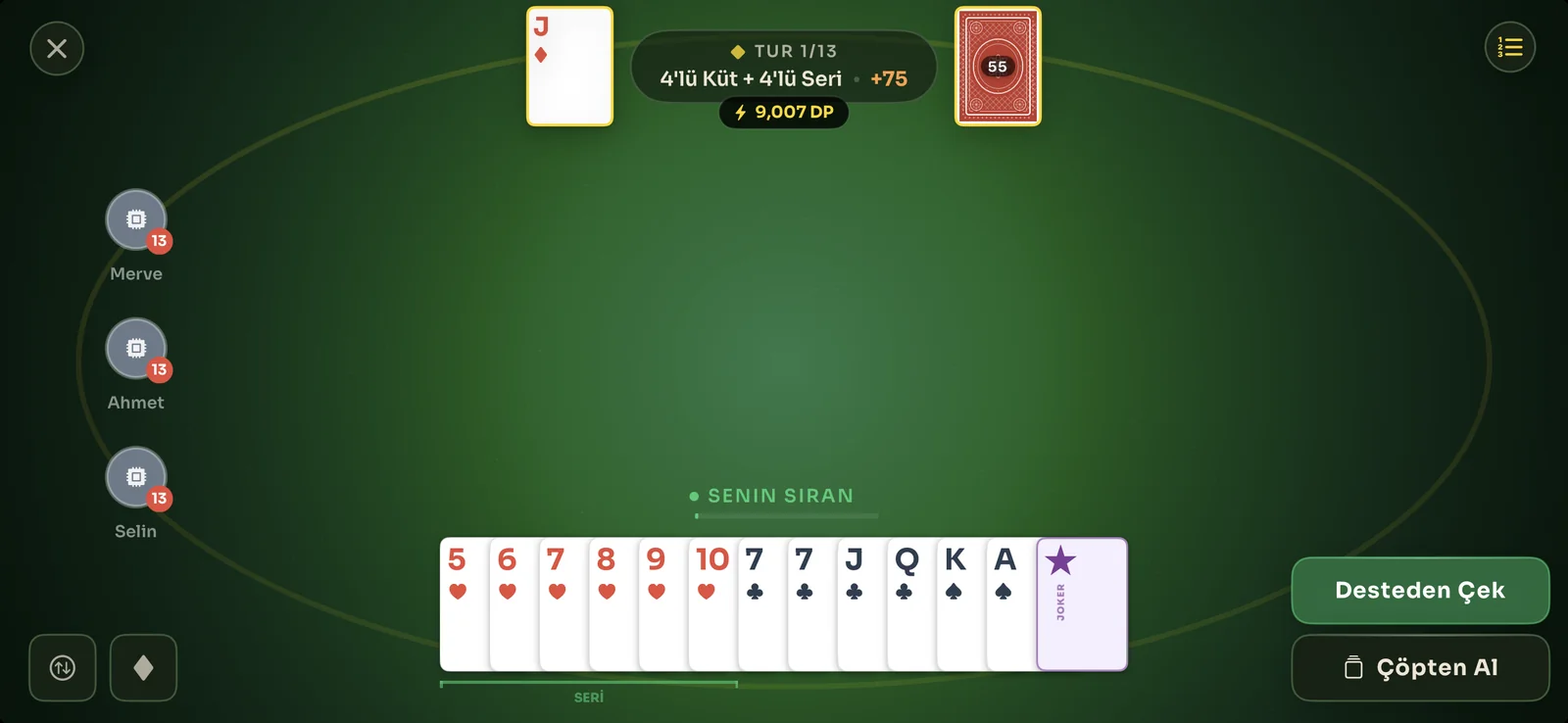
Look at the hand in the table screenshot above, where the starting player is choosing:
5♥ 6♥ 7♥ 8♥ 9♥ 10♥ · 7♣ 7♣ · J♣ · Q♠ K♠ A♠ · Joker
Count how many cards each contract still needs:
- Contract 1, two 3-card Seri (50): already complete. 5♥ 6♥ 7♥ and 8♥ 9♥ 10♥ are two runs, and Q♠ K♠ A♠ is a spare third. 0 cards missing.
- Contract 3, two 4-card Seri (50): also complete. 5♥ 6♥ 7♥ 8♥ is one run, and Q♠ K♠ A♠ with the joker standing for J♠ is the other. 0 cards missing.
- Contract 4, a 4-card Küt and a 4-card Seri (75): the run is there (5♥ to 8♥), but the set isn’t. The two 7♣ count as only one card, because a küt can’t repeat a suit. With 7♣ and the joker you still need two more sevens of other suits: 7♦, 7♠, or the second 7♥. 2 cards missing.
The player in the screenshot chose contract 4, chasing −75 with two cards still to find. Contract 3 was the safer pick: since you can’t open on your first turn, that hand can open on its second turn, which gives it a strong chance of being first out, for −50. The difference between the two choices is 25 points if both work. If contract 4 fails to open, it costs 75 points plus about 100 in cards.
The general rule: pick the contract your hand is closest to, and only stretch for a bigger bonus when you are one card away. With 4 players and 13 rounds, each seat starts three or four rounds a game (the first seat starts four, including the final Elden Bitiş), so a few safe bonuses add up quickly.
A turn, step by step
Play passes to the next seat around the table. Each turn has three steps.
1. Draw
Take one card from the deck (Desteden Çek, Draw from Deck) or the top card of the discard pile (Çöpten Al, Take from Discard). Taking the discard on your own turn costs nothing extra. The one exception is a locked discard: if a card was already offered to every other player out of turn and nobody took it, the next player has to draw from the deck.
2. Play
If you meet the contract, you can open. If you opened on an earlier turn, you can add cards to any meld on the table, lay new melds and steal jokers. You don’t have to play anything; many turns are just draw and discard.
3. Discard
End your turn by discarding one card. Two rules apply:
- No joker discards, unless the joker is your last card.
- Don’t throw away a playable card. If the card you discard could be added to a meld already on the table, or could replace a joker there, the app stops you the first time: “This card can be played on the table! Discard again for +25 penalty.” If you discard a playable card again that turn, it goes through and 25 points are added to your round score.
The turn timer
Every turn runs on a timer: 30, 45, 60, 90 or 120 seconds, set when the game is created (60 by default). If it runs out, the game plays for you: it draws from the deck if you haven’t drawn yet, then discards a card from your hand. You keep your seat, but an automatic discard is rarely the one you would have chosen.
When the deck runs out
If the draw pile is empty when play passes, the round ends with no winner (“Deck exhausted”). Every player scores the cards in their hand, and the round’s picker takes the bonus as a penalty.
How to open your hand
Opening (açma) means laying your contract on the table, and until you have done it you can’t touch anything else on the table. The rules are strict and worth knowing exactly:
- Lay down exactly what the contract asks for, all at once, from your hand. For “two 3-card Küt” you put down two sets of three, together, in the same move.
- Every group must be exactly the size the contract says. In a “two 4-card Seri” round, a 5-card run doesn’t count. Lay four cards and add the fifth later.
- There is no points minimum. Unlike 101 Okey, it doesn’t matter what your cards are worth, only that the groups are right.
- You can’t open on your first turn of a round. The app tells you: “Cannot open on the first turn.”
- Opening is all you play that turn. You can’t add to melds or lay extra melds on the turn you open. You still discard as normal.
In the app, select the cards for your contract and tap Open. You don’t have to arrange them into groups: the app works out how your selection splits into the required runs and sets. The Open button appears once you have selected at least three cards, or two in a pair round.
Rule 5 has a cost that catches new players out. On the turn you open you are left holding your spare cards until your next turn, and if an opponent goes out first, they all count against you. Using the hand from the worked example: after opening contract 3 with 5♥-8♥ and J♠(joker)-Q♠-K♠-A♠, you are still holding 9♥, 10♥, 7♣, 7♣ and J♣, plus whatever you have drawn and minus your discards. On your next turn 9♥ and 10♥ go straight onto your heart run.
After you open: adding cards and stealing jokers
Once you have opened, the whole table is yours to play on, from your next turn onwards.
Adding to melds (işleme)
You can add cards to any meld on the table, your own or an opponent’s. Adding to an opponent’s meld doesn’t help them: the cards in your hand are the ones that count against you, wherever they end up.
- Runs take the next card at either end: 4♥ or 9♥ on 5♥ 6♥ 7♥ 8♥.
- Sets take a suit they are missing. A set that already has all four suits is closed. A joker can be added to a set only while it has fewer than four cards.
- Pairs can’t be extended, and jokers can’t be added to them.
You can also lay new runs and sets of three or more cards from your hand, in addition to your contract. In the app you can drag a card up out of your hand onto either end of a meld, or tap to select and use the Play button.
Stealing a joker
Once you have opened, you can take any joker on the table, from anyone’s meld, by putting down the real card it stands for. If an opponent has 5♥ joker 7♥ on the table and you hold 6♥, you place the 6♥ and take the joker into your hand.
Sets have one extra condition: a set must already contain at least three real cards before its joker can be taken. With 3♥ 3♠ 3♦ and a joker on the table, you add 3♣ and take the joker.
Stealing a joker is powerful, but it moves a 25-point card that can’t be discarded into your hand. Steal one when you can lay it down again soon, in a new meld or to fill a gap, not just to keep it out of an opponent’s hands.
Out-of-turn pickups
Amerikano lets you grab a discard when it isn’t your turn. The game calls this Sıra Dışı Çekim, the out-of-turn pick, and it works like this:
- It starts when a player draws from the deck. By drawing from the deck, the player whose turn it is passes on the top discard, and the game offers that card to the other players.
- The offer goes around in turn order, starting with the next seat. The first player to accept gets the card and the offer ends.
- Some players are skipped: the player who drew, the player who discarded the card, anyone already holding 21 or more cards, anyone who has used four pickups this round and, online, anyone without enough Draw Points.
- You have 15 seconds to take it or tap Skip. If you don’t answer, it passes.
- It costs you a card. You take the discard plus one extra card from the deck as a penalty, so your hand grows by two.
- The limit is four pickups per round, and pickups stop once the draw pile has no more cards than there are players.
- If nobody takes it, the discard is locked, the drawer carries on, and the next player must draw from the deck.
In online games each pickup also costs Draw Points, and the price rises with each one you take in a round: 1 DP for the first, then 2, 3 and 4. The discard pile shows the cost as a red badge, such as “-2 DP”. Games against the AI are free.
When is a pickup worth it?
A pickup gives you one card you want and one you didn’t choose, and the random card is worth about 8 points on average if it is still in your hand at the end of the round. Take one when:
- It completes your contract, or leaves you one card away from opening.
- It’s early in the round, with a full deck and nobody close to going out.
- The penalty card is likely to be playable, because you have already opened and the table has plenty of melds to add to.
Skip it when the deck is running low, when an opponent is down to a few cards, or when the card only slightly improves a hand that is far from opening. The game’s own AI treats each additional pickup as more expensive than the last and asks for a bigger improvement each time. That is a good habit to copy.
Elden Bitiş: the final round
The last round of every game is Elden Bitiş, “finishing from the hand” (shown as Empty Hand in English). It can’t be chosen early; the game picks it automatically once every other contract has been played.
Elden Bitiş has no fixed contract. To open, you lay down every card in your hand except one, in any valid mix of runs and sets, and discard the last card. That means you go out in a single move. The usual rules still apply: you can’t do it on your first turn, and a joker can only be discarded as your very last card.
Because nobody can open without going out, there is no adding to other players’ melds and no partial progress. Everyone else’s whole hand counts when someone finishes, which makes this the most expensive round in the game for the losers. It also carries a 150-point bonus for its starter.
A useful trick: if the card left over is a joker, discarding it as your last card is a joker finish, and every other player’s card penalty is doubled.
How scoring works, with examples
When a round ends, every player gets a round score, and the lowest running total wins the game. Scores can go below zero, thanks to the picker’s bonus. A player’s round score is worked out in this order:
- Card penalty: add up the cards in your hand (2 to 9 face value, 10 to K 10, ace 11, joker 25).
- Pair round: in a Çift round, every card counts double.
- Joker finish: if the winner’s last discard was a joker, every other player’s card penalty doubles again. In a pair round that makes it ×4, so a joker caught in your hand costs 100.
- Discard penalties: add 25 for each playable card you discarded after the warning. These are added after the doubling, so they are never multiplied.
- Bonus, for the picker only: minus the bonus if the picker went out; plus the bonus if the picker never opened or the deck ran out.
The round-end screen shows each player’s Cards, Penalty, Bonus, Round and Total columns, and moves on to the next round after 15 seconds.
Example: one round, two endings
Four players, contract 7 (three 3-card Küt, bonus 100), picked by you. Selin goes out.
- You opened, and hold K♠ and 9♥: 19 points.
- Merve opened, and holds a joker and 4♣: 29 points.
- Ahmet never opened, and holds A♦ K♣ Q♦ 9♠ 8♠ 6♥ 5♣ 4♦ 3♥ 2♠ 2♦: 70 points.
| Player | Selin’s last discard is a normal card | Selin finishes on a joker |
|---|---|---|
| Selin | 0 | 0 |
| You (picker, opened) | 19 | 38 |
| Merve | 29 | 58 |
| Ahmet (never opened) | 70 | 140 |
Now change one thing. If you had never opened, your 19 points would become 119 (or 138 with the joker finish), because the picker who fails to open takes the bonus. If you had gone out instead of Selin, your round would be −100. The same contract is worth anywhere from −100 to more than +100 to you, depending on how it ends, which is why the round picker decision matters so much.
Ahmet’s line shows the other lesson: never opening is expensive even without a bonus, because a full hand is all penalty.
Amerikano strategy
Choose rounds by distance, not by bonus
Before choosing, hold Show Hand and count the cards each remaining contract still needs. A complete or nearly complete contract is close to a guaranteed bonus. Two or more missing cards is a gamble, and the bigger the bonus, the bigger the downside. Rounds are shared, so a contract you pass on may be taken by the next picker; you can’t save it for later.
Open as early as the rules allow
Your second turn is the earliest you can open, and it is worth aiming for. Every turn you wait is a turn an opponent might go out while your whole hand counts. Opening also unlocks the table, so your spare cards stop being penalties and become cards you can add to melds.
Use the free draw first
Taking the top discard on your own turn costs nothing. Out-of-turn pickups cost an extra card and, online, Draw Points. If a card helps you, the cheapest moment to take it is your own turn.
Shed high cards that don’t fit
Aces cost 11 and tens and faces 10, while a 2 costs only 2. When a high card isn’t part of a run or set you’re building, discard it early, before someone goes out. Low cards make cheaper fillers for the end of the round.
Watch the table, not just your hand
Two numbers are always on screen: the draw pile count on the back of the deck and the card count next to each opponent. As the deck gets low or an opponent gets down to their last few cards, switch from building to emptying: play what you can and throw away your most expensive cards. The server-side AI does exactly this, becoming more urgent as the deck drops below 28, 16 and 8 cards and as an opponent gets down to five, three or one card.
Don’t feed the next player
If the player after you has a run going in spades, don’t discard the spade that extends it. Every card you discard can be picked up, on their turn or out of turn.
Treat jokers as a short-term loan
A joker in a meld is doing its job. A joker in your hand late in the round is 25 points you can’t discard. Use jokers to open quickly, steal them back only when you can use them again, and remember the joker finish if one is left at the end.
Pair rounds: count the twins
Every card has exactly one twin. If one 9♠ is already in the discard pile, your other 9♠ can only make a pair if you take that discard. Keep track of which twins are gone, and remember that every card counts double in these rounds, so dump high single cards fast.
Playing against the AI
You can play Amerikano offline against AI opponents: choose 2 to 5 players and the remaining seats are filled by bots named Merve, Ahmet, Selin and Deniz. No internet connection is needed, and out-of-turn pickups are free.
There is one AI level. Knowing how it plays helps you beat it:
- It picks its rounds at random from the remaining contracts, so it won’t save the easy ones for itself.
- It opens as soon as the rules allow, choosing the opening that leaves it the best remaining hand, and from the next turn adds every card it can and steals jokers it can use.
- It values its hand by points held, near-runs, cards of the same rank and how close it is to the current contract.
- It never discards a joker, avoids discarding playable cards, and prefers to throw away high cards that aren’t connected to anything.
- It takes out-of-turn pickups sparingly, and only when the improvement beats a threshold that rises with every pickup it has already taken that round.
The practical upshot: the AI races. If you hold back to build a perfect hand, it will often go out first. Open early and keep your hand cheap.
Playing online and Draw Points
To play with other people, tap Create Room or Quick Match in the game setup screen. Online games need an internet connection.
- Rooms can be public or private, with 2 to 5 players, the turn timer, 2 or 4 jokers and the game mode (Beginner, Advanced or Custom) chosen by the host.
- AI Fill, on by default, fills empty seats with bots so you don’t have to wait for a full table.
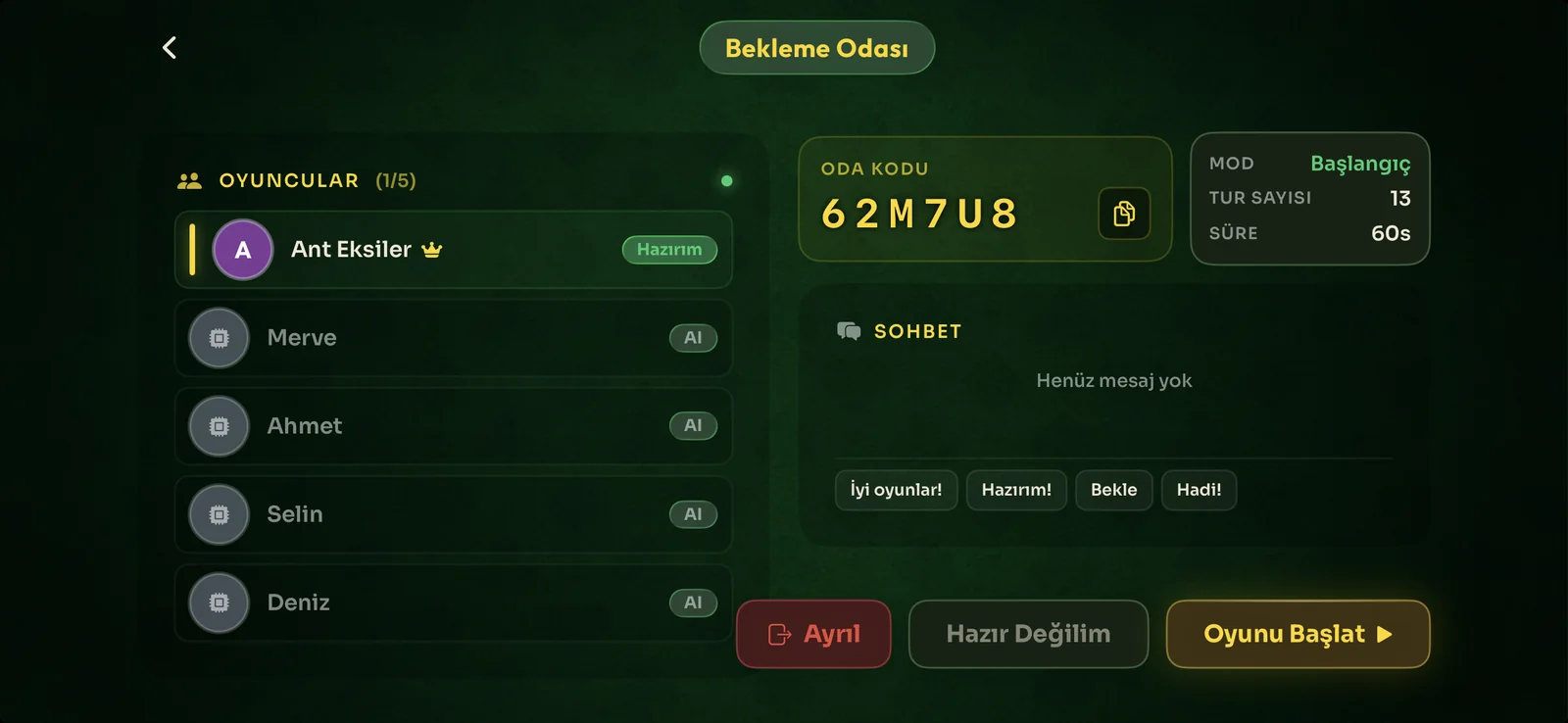
- Private rooms are joined with a 6-character room code of letters and digits. Characters that are easy to confuse, like O and 0, are left out.
- Quick Match puts you in the oldest public room with a free seat, or opens a new Beginner room with 4 seats, a 60-second timer, 4 jokers and AI Fill.
- In the waiting room each player marks themselves ready, and there is a chat with quick messages: “Good luck!”, “I’m ready!”, “Wait” and “Let’s go!”. The host starts the game once everyone is ready.
- If you leave or lose your connection, a bot takes over your seat so the game can continue. After about 30 seconds without a connection, the AI starts playing your turns.
Draw Points, plainly
Draw Points (DP) are the game’s only currency, and they have one use: paying for out-of-turn pickups in online games. Everything else, including every game against the AI, is free.
- New players start with 20 DP.
- Every day your balance is topped up to at least 10 DP, and consecutive days add a streak bonus: +2 on the second day, rising to +15 from the seventh day on. The main menu shows your streak.
- Watching a rewarded ad gives 3 DP, up to 20 ads a day.
- The Store sells packs of 50, 150 and 500 DP, with prices shown in the app in your currency.
The numbers fit together neatly: four pickups in one round cost 1 + 2 + 3 + 4 = 10 DP, exactly the daily top-up. Free play covers one round of maximum pickups every day, and in practice far more, because good players rarely take four.
Common mistakes
- Trying to open on your first turn. It isn’t allowed in any round, including Elden Bitiş.
- Opening with a group that’s too big. A 5-card run doesn’t satisfy a 4-card requirement. Lay exactly four cards and add the fifth on a later turn.
- Expecting to add cards the turn you open. Opening is the only thing you play that turn.
- Putting both twins in one set. Two 7♣ count as one card in a küt.
- Building K-A-2. The ace is low or high, never both.
- Ignoring the playable-card warning. The second time costs 25 points.
- Taking every out-of-turn pickup. Each one adds two cards to your hand and, online, costs more DP than the last.
- Holding a joker to the end. It can’t be discarded, and it costs 25 points, or 100 in a pair round that ends on a joker.
- Picking the biggest bonus instead of the closest contract. Failing to open as picker costs the bonus on top of your cards.
- Forgetting the deck count. When the draw pile is low, a round with no winner costs the picker the bonus.
FAQ
Is Amerikano the same game as Kut?
Yes. Amerikano is also known as Kut, and küt is also the Turkish word for a set of same-rank cards. It is a contract rummy: each round has its own opening requirement.
How many cards and players does Amerikano use?
Two 52-card decks plus 4 jokers (108 cards), or 2 jokers (106 cards). It’s played by 2 to 5 players, with 13 cards each.
How many rounds are there?
13 in the Beginner game, 17 in the Advanced game with pair rounds, and up to 20 in a custom game. Every game ends with Elden Bitiş.
Can you open on the first turn?
No. In every round, the earliest you can open is your second turn.
What happens if someone finishes with a joker?
Every other player’s card penalty for that round is doubled. In a pair round, where cards already count double, that makes it four times.
Who gets the round bonus?
Only the player who picked the round. They get minus the bonus if they win the round, and plus the bonus if they never open or the deck runs out. Nobody else’s score is affected.
Can I play Amerikano offline?
Yes. Games against the AI work without an internet connection. Online rooms need a connection.
Which devices and languages does the app support?
Amerikano is made for iPhone and iPad, and it plays in landscape. The game is in Turkish and English; you can switch language in Settings.
Take a seat
The fastest way to learn Amerikano is a few rounds against the AI: pick the contract your hand is closest to, open on your second turn, and keep your hand cheap. By the end of your first game the round picker will feel like the best part.
Amerikano is made by asquared, an independent studio in Istanbul making games and apps for iPhone and iPad. Step up to the green felt.